Wednesday, August 17, 2011

The Best Album I Own


Duncan Sheik’s PHANTOM MOON is the best album I own.

I’m someone who loves the absolutism of rankings and “best of” designations. As anyone who has asked me what the best pizza in New York or game in the Mario Brothers franchise knows, my opinions tend to skew towards the draconian and pedantic. But I’m not apologizing.

But even with my opinionated mindset I have a hard time pinning down one music album as THE BEST I OWN. Music is so mood-dependant, and my own tastes are so varied, that it’s counterintuitive that one thirteen-song collection could be like qualitatively head-and-shoulders above the rest. But here I am saying that the third studio album by that guy from New Jersey who wrote the radio tune “Barely Breathing” is more important to me personally then, I dunno, Pink Floyd’s ANIMALS or ABBY ROAD or GRACE.

Released in 2001, it got proportionally the amount of attention that a third studio album from a sometimes-touring singer-songwriter got in the pre-John Mayer age (the B.M. epoch, which is an apt designation because that guy is literally made of feces). This is to say—very little. No one has heard this. Adam turned me on to it years and years ago, and I have no idea how he heard it, though I chock it up to him being from New Jersey and just being awesome about knowing things.

It is painfully beautiful. It is tristful and susurrus, and other words I like that asymptotically approach a description of the mood it evokes. Evocative is only the beginning. It almost has a message to deliver, but seems uninterested in whether or not you receive it. Even further, PHANTOM MOON, more so then most albums, feels like it lives. Like it is something that exists and goes on and on looping its tracks ad infinitum, and occasionally you tune in to an old friend saying wise things who may not sound quite new or exciting but, god damn it, they get you and they’ve seen you grow up and they know you’re gonna be okay if you just keep on being the good person you are, you know? Maybe I’m projecting. This album is breathing alright, and not barely, it’s so vital and rich and—here is the kicker—MELANCHOLY rather than sad.

I guess that’s what made me sort of pine on it this morning, the dictional difference between these two words, and the mastery at which Sheik and co-writer Stephan Sater walk this line (correct, ten years later the pair would reunite to score the Broadway hit, and only fitfully good SRING AWAKENING….but this is so much better). Though the entire album is contemplative and raw; though many songs are richly minor in key; though it has slow, nagging moments that seem to be trying through sheer force of will to materialize in the physical universe as poetry or I dunno a fucking transcendent vista, it isn’t sad. Some tracks are upbeat and peppy. Some aren’t. But all of them make you feel like you are listening to honest-to-god music, something that doesn’t come around that often these days.

Track by track, it doesn’t miss a beat. Bookended by a prelude and full version of the enigmatic and sparse THE WILDERNESS, we understand Sheik and Sater are interested from beginning to end with those areas outside the bounds of the city and its neuroses, no love stories here, no terrestrial woe. It is larger than that. THE WINDS THAT BLOW and TIME AND GOOD FORTUNE seem almost a biblical in their importance, parables that have truth to offer if you’ll listen. MOUTH OF FIRE is the oddest track, with a palpable yearning, an almost sexual energy that the pair again would re-visit (with much more populist, broad strokes) in SPRING AWAKENING. LO AND BEHOLD is also something of a vague religious story, but doesn’t feel nearly as flimsy as a Sufjan Stevens joint. SAD STEPHEN’S SONG is not sad, but rather bubbling and surreal. It feels like a musical version of “The Love Song of J Alfred Prufrock.” They have always existed in the same room in my mind and both claw at the same dream-logic and sensibility. (maybe it’s all the “Mermaids” imagery, but it has got to be more than that). It’s the best track on the album.

I could go on. And you’re probably not reading this because there’s nothing worse than an album review for an album you haven’t heard. Or you think I’m lame that such a crooning, serious work is “my favorite.” I could protest that I like all sorts of music and that I love the energy of dance or hip-hop, but I feel like that’s the equivalent of that white woman yelling ”I’m educated!” to the conductor who tried to quiet her down on a Metro North train. So I’ll stop there. But if you want a meaningful CD for an afternoon at home, or busywork in the office, or really anything less energetic than running at the gym, you can’t beat this one.

By the way, the best pizza is Di Fara and the best Mario game is Mario 3. Definitely.

Monday, July 11, 2011

GOOD KID


In the interest of full disclosure I saw TERRI mostly because my roommate works for ATO pictures, the company that distributed this small indie feature and Sundance hit. And, to continue with the honesty, I was expecting the film to be worse than bad—a lugubrious fat-kid-coming-of-age story a la PRECIOUS, with a white obese protagonist and John C. Reilly in the Mariah Carrey role. Leaving the theatre, I was delighted to find TERRI was something wholly other than what I expected, that despite its setup and (sorry, Jesse) pretty bad trailer it is something PRECIOUS was not even for one moment: good. This is a good movie, a very good movie in moments, and one I wish more people would huff off to see.

And why is it good? Well it’s related to the very fact that is it so stridently un-PRECIOUS, in all senses. The simple storyline, a taunted fat kid plods through a grab-bag of high school moments with the help of some misfit friends and a good-natured principal who sees his potential, betrays the film’s complexity and the skill of its creators. There’s more honesty in Terri’s fat little finger than in the rotund entirety of PRECIOUS, and this honesty comes out in perhaps by favorite filmic way: lack of causation. The script is so loosely-plotted and dreamily-directed that you never quite know what’s going to happen, what people are going to say, what tone is going to be struck, what shots are going to hold, what cuts are going to pull us away from such gossamer emotional tableaus. The events of one scene certainly inform the next, or a scene five or six down the road, but there isn’t an urgency to the proceedings here. Terri just exists and wanders through these scenes, hobbling in his way, and this allows us to accept him as a real character rather than simple a conceit (Precious existed only to eat fried chicken and get punched round by Mo’Nique, Terri lives and breathes on camera and off). In another film maybe such a peregrinating pace and lack of cohesion would be a flaw, here it saves the film entirely.

That is, coupled with another element of TERRI which I love, and also saw recently in the simply-playing (and similarly-distributed) WIN WIN. This element is that Terri (like the blond-haired wrestler in WIN WIN) is something we see shocking infrequently in the movies these days: a GOOD KID. The movie prefers a more evocative term—“a good hearted kid”—but we know Terri because we know people, and we know he’s just kind of a good kid, just as we know others are just kind of bad kids. The more facile and surely-easier-to-write version of TERRI or WIN WIN is to show the kid as a guarded asshole, angry at the world for its juvenile injustices, on the verge of ‘pulling a Columbine’ or trying to off himself at least, pulled back from the brinks of despair by the one person who will look at, AND REALLY SEE, the person they are inside. Terri doesn’t belabor us with such a hoary cinematic calculation; we get something so much less certain that the only other thing it can be is true. Instead of watching the familiar character change and be reborn as someone who doesn’t reject adult authority (FREE WILLY, I’m talking to you...), we see a kid that just starts out good, that we can root for because they are so good-natured in the first place and we want them to stay that way.

And, despite the trailer suggesting otherwise (it presents the film as something of a two-hander, John C. Reilly’s character helps Terri negotiate high school but TERRI teaches his principal something about dealing with his own problems, in the form of his contentious wife), the film doesn’t pander to us with the egregious suggestion that this is really John C. Reilly’s story. We don’t meet his wife or ever see him break down and “confide” in Terri beyond a very casual, natural, relationship-appropriate way. When Terri stumbles upon John C. Reilly sleeping in his car in the school parking lot one sunny Saturday morning, we can piece together he’s been there all night after fighting with his wife. The film doesn’t need to belabor or even MENTION this, it respects our intelligence enough to allow the pieces to be the pieces and for the filmmakers to just play with them without unnecessary explanation. This is Terri’s film, and John C. Reilly is an incredibly empathetic principal, wise in such a brilliant and almost suburban way, a goofball but meticulously not weird. But it’s a triumph and even a central pillar of the film that it doesn’t delve into the principal’s personal life much, that his wife never appears, that Terri doesn’t ask him TOO many questions or offer TOO many canned pieces of folk wisdom (those all come, appropriately enough, from the principal himself...to help Terri with his own doubts and problems). This may be, deep down, a symbiotic relationship but it is never CALLED THAT, and that's why it is therapeutic or transformative for the young man.

So no matter what, don’t accuse it of being PRECIOUS: despite its indie themes, bemused tone, soft lighting, piano score. TERRI is everything it is because of the things that it so stridently is not: it refuses to yield to such “classic” indie tropes that have no truth to them, that may tie up the script but leave us stranded emotionally. Terri’s absent parents don’t reemerge and cause crisis (and that’s where WIN WIN buckled under cliché); Terri’s sickly uncle doesn’t die and cause him to reevaluate life. Terri’s weird rat-catching fascination or pajama-wearing isn’t riddled with specious psychoanalytic content (thank god he doesn’t slip on jeans in that final scene). The inevitable drug binge doesn’t lead to dramatic stakes and maudlin consequences (Terri’s friend pisses his pants, but nobody overdoses, nobody seizes the moment to steal a kiss). Terri never snaps and shoots the school bully. He doesn’t begin to diet. The film doesn’t demand narrative justice because it knows the universe doesn’t either, and it is infinitely wiser because it doesn’t have to be wise.

Thursday, June 16, 2011

SUPER 8 MY HOMEWORK


For months I had looked forward to JJ Abrams (LOST, ALIAS, the latest STAR TREK film) secrecy-shrouded feature SUPER 8, his homage to his once-hero and now-mentor Steven Spielberg and his awesome grab-bag of iconic ‘family-adventure films.’ Some Spielberg directed (E.T., RAIDERS OF THE LOST ARK, CLOSE ENCOUNTERS OF THE THIRD KIND) and some he just produced (GREMLIN, THE GOONIES), but his trademark stamp is impossible to ignore. Usually it takes kids and sends them on big adventures, pits them against big enemies, stacks against them what seem impossible odds and, experiencing these adventures and enemies and odds alongside them, we remember what it feels like to believe in magic.

SUPER 8 is also a lot like CLOVERFIELD, the monster-attacks-city movie from a few years ago that JJ Abrams produced and I loved as an allegory to 9/11 anxiety that there is nothing scarier than something loud and destructive slamming against buildings in New York. In SUPER 8 the fear is decidedly more post-9/11: there’s a monster out there that the government knew about but had covered up. It’s Patriot Act horror: what happens when the lies we aren’t told “in order to protect us” get out? What will we do if we aren’t prepared with the truth?

Unlike the claustrophobia of CLOVERFIELD (which forced us to recognize the “big city” was just a series of small spaces in which we could get trapped) SUPER 8 sets are sprawling, airy, idyllic expanses. The monster destroys plenty because he has plenty of room to destroy – but it’s a different kind of threat than that of his counterpart loose in the narrow, skyscrapered lanes of NYC. Somehow, because it has more room to run amuck, the creature feels more like an angry puppy than some unholy beast from beyond. It isn’t as real of a threat; the materials it demolishes aren’t hard steel and concrete but trees and houses, like a child destroying a Lego set after having too many grape Kool-Aid Kool Bursts. In fact, while CLOVERFIELD felt like it had a setting (however glossy or embellished), SUPER 8 feels more like it’s simply on a set – production values may be high (the call for “production values” is the mantra of the child-director making the zombie movie in the film) but this isn’t quite cinema verite.

And that’s the general vibe of SUPER 8 and one that works for it fairly successfully. It is also in line with J.J. Abrams postmodern tendencies to care more about storytelling than (and this is certainly the case here) the story. SUPER 8 is a monster movie about kids making a monster movie, and so throughout it all are touches of the wide-eyed DIY qualities that any kid fucking around with his friends and a camcorder know so very well. I look back on my own experiences being a film geek alongside childhood friends with nostalgia and, yes, some embarrassment (side note: I’m still upset I was never part of Josh’s original home video ATTACK OF THE AMISH, which somehow, despite my having nothing to do with it, stands like an obelisk in my memory: “when you’re buttons are all gone, and your VCR ain’t there, and you can’t find your blow-dryer so you can’t dry your hair…Attack of the Amish!”). SUPER 8 aspires to and tributes a prepubescent feeling of almost pre-embarrassment: when everything was possible, nothing is shameful; when the world was full of stories and ambitions and nights to almost-kiss the girl of your dreams. This is surely Spielberg’s modus operandi and maybe such puerile goodwill has no place in the cynical world of government-sanctioned lies and outsized threats from outer space….but for a moment, before the train crashes, before shit hits the fan, when the kids are filming and the night is warm and Elle Fannings’ sort of outrageously good performance hits just right, there is a bit of magic. It is ephemeral and slippery, and Abrams loses it surely, but it was there. You know it when you feel it.

I wish there were more attention paid to SUPER 8 clever Brechtian alienation and less to its undeniable faults. When the child director rewrites scenes to illicit an emotional response from the audience in order to “to make them care” it’s more than a tongue-in-cheek Ha-Ha aimed at the “real” audience; whether or not you know what your laughing at it’s actually the postmodern attribution of “standards” to a genre. Just as SCREAM taught us a lesson we didn’t-know-we-already-knew (never say: ‘I’ll be right back…”), so does SUPER 8 concern itself with concepts one Russian-Stacking-Doll further out from what’s physically going on on screen. But maybe SUPER 8's problem is that of the SCREAM sequels (2 and 3 anyway…I can’t bring myself to see 4): it’s a clever way to speak but there just may not be that much to say. Abrams has almost nothing to add to Spielberg’s family-friendly wonderment/awe/catharsis formula, so the best he can do is try to replicate it, and quite frankly, he can’t. He did his homework on Spielberg, fine, but he didn't CREATE anything that's his own. It's a mathematical problem that doesn't seem to occur to Abrams: no matter how perfectly you solve an equation, it isn't the same as designing a theorem. It isn't as elegant.

Further, in caring more about storytelling than story, Abrams overestimates his storytelling, because the story blows. Full of holes and inconsistencies, falling on trope and convention in an almost lazy way, populated by adult characters whose hokey motivations are straight from 1993, what actually happens in SUPER 8 doesn’t matter at all. We know where this train is heading and we know that, even if it is detailed along the way, it’ll get there somehow. The children are the bright spot here (‘manipulative!’ cry haters) and a reason to see the film; ironic since it’s famously-coy marketing campaign teased the monster itself as the carrot on the stick. The monster, sadly, disappoints—sort of Clifford the Big Red Dog meets the CLOVERFIELD Monster, with of course the motivations (and table manners) of E.T. Its design is far too similar to the CLOVERFIELD monster—which is inexcusable really because the thing could have looks like ANYTHING to tell the story Abrams was telling. It’s nothing but a creative failure, any way you splice it.

I don’t begrudge Abrams the intellectual preoccupation with Spielbergian convention, hell anything that successful and populist should be carefully considered, but SUPER 8 would have been better if Abrams had the creativity or gumption to give us some major BREAK from this convention, not only to surprise and entertain us but also to further educate about what it means to be a Spielberg movie in the first place. Instead of something original, we get an ending right out of E.T., made even further flaccid of course because we’ve seen it so many times since. The misunderstood alien goes home, the kid’s are vindicated as more than mischief-makers, life returns to normal. SUPER 8 fails to distinguish itself in the end, a common failing for so many action movies I see, but here it’s somehow even more toxic to the overall film: what’s the POINT of seeing SUPER 8 when E.T. in streaming on Hulu? What’s the POINT of caring when it all ends the same way?

And so, yes, not exactly the ground breaking film I was hoping for nor the latest monster to haunt my geeky monster-movie dreams. Still, I defend SUPER 8 as a well-made film. And it’s innocuous, hardly a compliment usually but here it almost (almost!) is. SUPER 8 trades in its innocuousness, its ability to neuter the monster movie and make it a family film – an idea that may be clever, that may be postmodern, that may operate successful – but that doesn’t necessarily mean it’s a good idea.


The cross-branding writes itself. Till next time, you monsters.

Tuesday, June 07, 2011

CHILD LEASHES: A Defense


Yes, I hate GLEE. But I wanted to take a few minutes to un-‘leash’ another diatribe, or at least a sort of aimless philosophical exercise, if you’ll grant me the utter nonsequitor.

At Starbucks yesterday evening (the one near my work; where I’m mayor; where I enjoy a level of popularity among the sassy baristas unparalleled in any social arena at any point throughout my life so far. Free coffee is only the beginning—Tricia told me she wanted to “feel me up” yesterday when she gave me my latte) two women were waiting for their Frappacinos when one of them saw something outside that made her cry: “OH GIRL…HELL YES. I NEED ME ONE OF THOSE.”

“What now?” her friend said, looking. Awaiting my own coffee, it was either eavesdropping or reading the track listing for the 300th time on the Deathcab CD that Starbucks is now selling. Haven’t heard it, but great track titles.


I assumed, both because these women were quite fat and because I am an asshole, that she had seen some sort of food product, perhaps a churro. But then I saw what captivated this woman so: outside there was another large woman wearing a Mickey Mouse shirt with two red-headed children attached to…could it be…CHILD LEASHES?? This was seriously something out of the classist third act of MILLON DOLLAR BABY. Utterly splendid.


The Starbucks woman was impressed—could those really be the first kid leashes she has ever seen?—but her other friend, obviously a more dogged defender of personal liberty and individual freedom of locomotion—told her she was crazy, “LEASHES ARE FOR YOUR CAT” she reasoned.


Okay, so she didn’t have the particulars right—I mean a cat leash is just insane—but generally I agree with her. And we all do, right? It just feels wrong, leashes are for pets, tying up children is cruel and neglectful (as far as TYING ANYTHING TO YOUR PERSON can be considered ‘neglectful’). It’s just plain old wrong.


But sitting on the subway home, I kept musing on this incident and my visceral reaction to it. What’s so wrong about a parent choosing to tether their child, so they don’t run off and get hit by a car, or kidnapped by Tricia the barista, or eat that weird feathery thing lodged in the crack of the sidewalk. I’m not talking about like elaborate and painful harnesses and cat-o-nail-tails cracking their flanks if they get distracted by the ice cream man and break stride, I’m just saying – is it really so different than strapping a child into a car or bike seat? Or going with them on a two-man float on a waterslide?

This is one of the many examples in my life where my initial, egalitarian, liberal, “enlightened” reaction sort of chaffed against a more slowly-determined and reasoned analysis. I’m not sure I think all kids should be manacled to their mothers—some are better off getting as far away from mom as they can, hell this particular one was wearing a MICKY MOUSE SHIRT. It’s when leashes replace responsible parenting that I think we have a larger problem, but I’m not sure why we can’t have both.

In a vacuum, kids should be able to roam free and sprinkle their joy and puerile wonderment on all things they touch. In reality, they break shit. What it comes down to is if we live in a world where parents take personal and financial responsibility for their child’s safety and liability for the damage they cause, throwing a rope around their neck and commanding—patiently yet firm—WHOOOO DOGGY may not be the worst thing in the world.

And he never babysat again.

Friday, May 20, 2011

GLEE-FUL DISDAIN


As we’re only two days from the RAPTURE there’s something I have to get off my chest. Seriously…

…okay here goes…

I hate GLEE.

There, I said it… I feel better now. There probably isn’t another more incendiary three-word comment I could make to The Facebook Community. Maybe “Yoga is Retarded” (ohhh, that’s a good one). It’s my own private version of wearing a ‘Jeter Sucks Arod
 t-shirt on a lazy Sunday at the Bronx zoo.

Why? Because I’m supposed to like GLEE. Glee is doing great things, right? It’s getting people to watch a new scripted show. It’s a least periodically funny with its biting jokes and greased-lightnin’ pace. Most of all, it is THE undisputed champion of egalitarian discipline, the bastion of tolerance we need in a world where gays are bullied, fat people are ignored, and cheerleader/jock romances go too often unrequited.

But I hate it. I hate its stupid face and its stupid songs. Here are three reasons, two of them frivolous:

1) CHARACTERS:
The characters on GLEE are some of the weakest-drawn I have ever seen on network television. I look back at the show like FRIENDS and I think, wow those characters were so shallow and predictable, the eccentric Phoebe or simple-minded Joey never breaking stride in ten seasons of stock-scenarios. But if the cast of friends existed in the world of GLEE they would be Supreme fucking Court Justices. GLEE has not one character with an iota of the believability of Matthew Perry’s Chandler, and that is a major problem, because Chandler and the rest never seemed like real people to me. Maybe that’s where I depart from many of my peers, who watch shows like FRIENDS or SEX & THE CITY and are quick to identify, quick to delineate character-types (“I’m a Miranda with a bit of Carrie when I’m drunk on bellinis”). I don’t have that tendancy, although to be honest I’m like mostly a Jack with some Sawyer thrown in for good measure.

2) SONGS:
Dreadful. Not even a little bit good. Some of them are catchy but that’s because the original songs were good. I can play a couple of bars of moonlight sonata, I can even jazz it up with a left hand riff anachronistic to Mozart, but it doesn’t mean I’ve reinvented the wheel. Watch MOULIN ROUGE and you get the idea – oh yeah, I sort of like Elton John’s YOUR SONG. So go buy an Elton John CD. Baz Luhrman at least stylizes his work, the frenetically mashed-up visual style matches the musical schizophrenia. GLEE’s plundering and reorganization is more insidious -- in a show with no style whatsoever, it makes music worse by adding nothing. It’s a creative asymptote, no matter what they do there’s nothing they can add; it’s never the original, and it will never be better.

3) THE NEUTERING, FACILE, MIND-NUMBING POLITICS (AKA the Characters)

Yes, to return to the characters for a second, we don’t just have flat characters, we have characters that I feel actual negate some of the good GLEE purports to do. The not-actually motley crew of Glee club members include the following well warn tropes: the Dumb-but-Dimpled Football Quarterback; the Histrionic Go-getter; the Punky Asian; the Fat Black Girl with Pipes ya’ll; the Lipstick Lesbian; the Dumb Blonde Cheerleader; the Inoffensive-but-Bland cheerleader (also blonde); and, of course, the Gay. This veritable Burger King Kids Club of a crew even has its own Wheels.


The point of every episode and every second of GLEE is that NO MATTER WHAT CLIQUE YOU FALL INTO, YOU’RE WORTHWHILE. That the long-sought great equalizer of high school politicking is here a glee club choir is mostly besides the point, rather that there is SOMETHING that makes everyone valuable and worthwhile, no matter who they are fucking, praying to, or modeling themselves after. Fine, great. But something about GLEE seems to betray its message, for in its cookie-cutter approach to the various archetypes of a middle American high school, we ignore how vastly different people can be, even gay people (some play sports!), even jocks (some are smart!), even cheerleaders (some are brunette!). Having a gay character, even a likeable gay character like Chris Colfer who stands by his friends and sticks up for his principles, isn’t half as brave or philosophically important as having a character who happens to be gay, but whose entire character isn’t defined by this trait. Whose sexuality is, finally, besides the point.

By wearing each characters’ dominate trait on their sleeve, GLEE positions these traits as ‘handicaps’ – handicaps that don’t matter, they argue, but handicaps indeed. We got a Jew, an idiot, and a red-head gay—but that’s okay because we’re ALL IN IT TOGETHER. WE ARE THE LITTLE RASCALS. WE ARE THE OUTCASTS. GLEE is a show for the outcasts, which revels in the fact that there are more of us out there than anyone thinks.

But by asserting its own anthemic qualities, GLEE reminds me of the latest commotion around Lady Gaga – a self-proclaimed messianic juggernaut that we’re supposed to like because they claim to speak for us at last. Casting aside Gaga, or GLEE, is then equated with casting aside parts of yourself: self-hatred, the arch-nemesis of the enlightened soul.

Look, there are worse things on Fox and in the world. Of course its message of love and acceptance is meritorious and I don’t begrudge GLEE for being at least on the right side of the political fence. Creator Ryan Murphy isn’t the devil, and for all his travail to bring the world GLEE’s important message I’m sure he’ll be raptured in a couple of days (oh wait, he’s gay…maybe not). I just hope that, in Heaven or wherever, he makes better TV than GLEE, because its creative and philosophical sins are numerous. And because commanding the National Ear is a hard trick to pull of, once you do, it becomes a responsibility to shout, a capella, a message more all-encompassing than “I’m Okay, You’re Okay.” When the conversation isn’t about acceptance but rather acknowledging the insufficiency of stereotypes, we’ll be a lot closer to where GLEE—in its good-natured attempts—wants us to be.


Oh and it’s so god-damn boring.


*


THANKS FOR READING MY BLOG, SEE YOU IN HEAVEN, I’M OUT PEACE

Tuesday, May 03, 2011

HATE-RIOTISM: THE WAY WE WIN


Oh beautiful for spacious skies
For amber waves of grain
For Purple Mountain’s majesties
SHOOT THAT MOTHERFUCKER IN HIS EYE!!!


***

The rockets’ red glare kept America up Sunday night, as soon-to-be-second-term President Barack Obama took to the podium at nearly 11:30 PM in the White House’s east room to make the announcement George W. Bush made hundreds of time, but only in his (probably wet) dreams: Osama is dead. Freedom wins. Count it.

Well, frankly, I’d count that a three-pointer, because there is no greater coup, no single symbolic thing, no more important victory for America’s military policy than the tracking down and killing of this wicked, wicked man. Rarely has a forty-minute military raid have had such metaphorical significance for the country that undertakes it. Whether or not Osama’s death translates to actual physical consequences for international relations or domestic policy is anyone’s guess (I’m leaning towards no), but the thing itself—as a pure symbol, as a signifier—it is as big as it gets.

AS BIG AS IT GETS.

Faced at last with a shared joy proportional to that shared loss we all experienced on in 2001, I reflect on that precious egalitarian and communal spirit that we see among Americans in the worst of times – those Blackouts real and figurative, those grossly-outsized wars that threaten more than our lives and livelihoods but our ideals and values, those darkest hours of our darkest days. We band together; we persevere. So how does America celebrate such an immense joy, such beautiful and dramatic closure to the nightmare of 9/11 and the decade-long war that followed?

Shots! Jose Cuervo. Those mini kegs of Heineken, never cold enough. Lemon Drops. Sex-of-The-Beach shooters. The Flaming Moe.

Lo, we’ve seen the Promised Land and it reeks of Milwaukee’s Best!

I do not deny that this is a time, and a cause, for celebration. But the tenor of the downright partying that has characterized both the world trade center site and midtown at large makes me, at best, uncomfortable…and, at its worst, a little ashamed. The language of this revelry is overbroad, and the posture of the revelers is, in some ways, threatening. DON’T FUCK WITH US, BECAUSE THIS IS WHAT HAPPENS is what this says to me. That general tone much more closely resembles in some ways the jingoism of Bush than the measured but committed tactical pressure of Obama’s military command. What’s the problem with jingoism? I guess nothing, on a theoretical level, as jingoism is just extreme patriotism with a military panache. But as wielded by Bush and his generals, jingoism was a form of jingleism – a procession of meaningless sayings: “mission accomplished,” “smoke em out,” etc. – that distracted from what was really going on: horrific acts of cowardice, staggering acts of bravery. War, very real war, with loss of limb! And life! Broken homes. The lasting effects of tedium and demoralization on young soldiers. Friends who never come home. Stories cut short.

It’s sad to me that the relief and closure Americans feel at this moment can’t be expressed more articulately than a drunken shanty delivered on the backs of off-tune bagpipes. The DAILY SHOW’s “moment of Zen” had it best: a fresh-faced twenty year old college kid at Ground Zero at 1 AM on Monday morning bellowing: “I have two finals tomorrow…but I’m not going to study because WE JUST KILLED OSAMA!!!” This kid was maybe ten when the twin towers fell; likely he doesn’t even remember a skyline that included their iconic silhouette. Yet the rage bequeathed to him by a generation flabbergasted by the events of 9/11 is certainly in tact. And, now that Osama is dead too, the jouissance of victory is his to claim as well. He's earned that.

I know I’m not alone in my dismay here. Some have pointed to Proverbs 24:17, which reads, "Do not gloat when your enemy falls; when he stumbles, do not let your heart rejoice." Some have invoked Gandhi in suggesting that utter scorn for ones enemy only creates further conflict. Yet, while it may eventually make the world blind, sometimes an eye does deserve an eye (could there have been a more perfect place for the fatal shot to have hit?). Osama deserved to die, there is no doubt, and no amount of liberal pussy-footing is going to change that fact. But just because someone deserves to die, and just because they are killed, and just because killing is – in this limited and unfortunately circumstance – justified, doesn’t mean it’s something to celebrate. At least not in that way. Instead maybe we should hold our family and friends near, recognize those that didn’t live to see the day in which, as Obama put it, “justice has been done.” Don’t cry about it, for God’s sake, but take it easy. Reflect joyfully, and be optimistic for a future where retribution isn’t the reason to cheer. Where we don't have to murder murderers, because murders aren't so.

Like probably every one of you, I’ve sat through enough enervating sermons to have wandered to the “Psalms” section of GATES OF PRAYER and noticed—with some sort of misplaced, puerile glee – all FOUR verses of “America the Beautiful” written out. And to think, our Elementary Schools teach us but one—and definitely the weakest—of these noble stanzas. The one I turn to now seems particularly apt for this moment of national celebration and memory:

O beautiful for heroes proved

In liberating strife.
Who more than self their country loved

And mercy more than life! 

America! America! 

May God thy gold refine

Till all success be nobleness

And every gain divine!

Nifty little verse, which stirs a prayer in my heart:

It is beautiful that our heroes—our servicemen, our municipal workers, our parents, children and friends—after nearly a decade of travail and sustained effort to fight for the cause of liberty, have proved their cause to be just. America! It is incredible to reflect on the country that is ours. May God continue to grant us pure wealth, the wealth of a life of freedom, and let our heroes’ successes be the hallmark of our unique and amazing country. But only when our success is NOBLENESS, when we are proud of both our wins and of the way we win, will we have truly—and indelibly—won.

Tuesday, January 25, 2011

IN/CIVILITY

...

Following my post on Commodore Palin, and after reading Brian Lowry’s column last week (Variety, January 19, 2011), as well as much commentary on Armond White being literally the devil (http://www.nypress.com/blog-8067-connect-the-dots-how-to-criticize-a-critic-when-he-doesnt-play-the-game.html; thanks Joe), I thought I should opine—because my self-aggrandizing, flabbergasted self thinks such things—on the idea of ‘incivility’ in film reviews. I’m talking about the bitchy, caustic climate of online reviewing, altered indelibly as “amateur” film buffs worldwide have access to (however poorly-read) platforms for their ideas.

Twitter gives Joe the Plumber a voice after he belched his way through FURRY VENGENCE (‘genius!’), and lo if I had a blog back when I realized BOYS AND GIRLS: SEX CHANGES EVERYTHING (starring Freddie Prinze Jr, 2000) was the first portend of the prophesized end of human society. Friends have recently given me shit for switching to the Jets (a decision three years in the making, assholes), but I’ve long received guff for a perceived negativity in my movie reviews. When I admitted to someone I hated BLACK SWAN, another friend issued the caveat: “but that’s okay, because you hate every movie you see.” Aside from its outright inaccuracy (don’t make me enumerate, again, the list of movies I ‘liked’ over those I did not like from last year --the ‘likes’ far outnumbering), I always fail to understand these sorts of comments: there is just simply a lot of shit out there and I know what I like and what I don’t.

I guess, though, I do understand a perceived negativity but I think it comes not only out of rhetorical style but also a particular psychological bias on the part of many moviegoers. Starting with rhetoric, yes, I’ll be the first to admit: there’s a certain annihilating flamboyance to my writing: at it’s lightest, a penchant for hyperbole; at it’s most hyperbolic, a douchebaggy cockiness that thinks it knows better than everyone else. After all, it’s not like I directed TITANIC, who am I to say AVATAR is a partial birth abortion of a sapphire fetus? Filmmakers, even bad ones, contribute SOMETHING – a ‘work of art’ or at least a reel of moving images – that didn’t exist before. Criticism, at least chronologically, comes after the abiogenesis of the “something” -- and so, because it doesn’t stand on it’s own, it is more reflexive to societal trends, individual tastes, and general a priori deductions than filmmaking is itself.

As an example: as my friend Adam pointed out to me yesterday, a few early reviewers called TRUE GRIT “good but not one the Coen’s best” and this stance has been subsequently bequeathed onto the critical community, and its readers, at large (until, perhaps, today -- with the Oscar nominations giving credit indeed where it is due. Winning’s a different story.) Maybe, and this is certainly up for debate, this is true -- but the truth is wholly besides the point. To repackage all this: critics comment not only on a particular piece, but the entire EXISTENCE of that thing, its coming-into-being, its “hype,” its historical significance, its ‘worth,’ its flashes of nudity. This isn’t the crucible of art, but of journalism, and thus there is a level of discourse that can definitely seem hostile, inhospitable, even ‘bitchy.’ It’s true, as Lowry points out, “On the internet, it’s often difficult to get noticed without raising one’s voice” and while that is a timely and dulcet lament, I’d counter with what I tell my parents when they can’t work the ionic breeze we bought at Brookstone – deal with it. This is the way of things, this is how communication sounds right now, so we either whine about how great the record player picked up those deep tones or we talk about how to maximize and learn to operate under the latest dispensation. I’m not dogmatically for “Out with The Old,” I’m just pointing out that a LOUD VOICE doesn’t necessarily mean one without points to make. It may be a bit grating, or self-congratulating, but being ebullient or dismissive doesn’t necessarily mean being uncivil. It CAN mean this, for sure, but doesn’t have to. And even if it’s a bit uncivil, in the sense of being a bit brasher than ‘polite society’ generally permits, so what? Even though I think BLACK SWAN is the most egregiously overrated, actually-shitty movie of the year, I don’t think all the people who liked it are moronic assholes. I’d never say this. Loudly saying my opinion on the film, even obstinately in an aghast state, isn’t an attack on you. Feel confident enough in your own tastes to not let the taste of some douche on Facebook offend you so personally.

So we are dealing rhetorically with a problem of “mood” – modern English, lacking a working subjunctive, doesn’t suitably moderate “I believe this movie sucks!” in the way that, say, Spanish would. But we are also dealing with (I mean ‘I believe we are dealing w-- – oh fuck it) a psychological bias, whereby people seem to LIKE more than they DISLIKE things they spend time and money on. I know that’s offensive and ego-dystonic, but I happen to think it’s true. It’s a bad habit – and one I’m often guilty of myself – but (relax) it’s also understandable. Being of limited resources, and desiring generally a state of happiness, I want to feel my purchases are wise and time well-spent. But often I go to the movies and only eat half the large popcorn I paid for; often I have high hopes that are dashed by a mediocre film. This doesn’t make me a fool for having high hopes, and it doesn’t make me a snob for not “just going with it” because (‘after all’) it’s “only a popcorn movie” or it “was just supposed to be fun”. Popcorn movies are fine, fun is fine, not everything needs an elaborate and cerebral metaphor, in fact I wish LESS movies had central metaphors, but there is nothing to be ashamed of to acknowledge that BLADE TRINITY was BAD. X3 was BAD. MARIE ANTOINETTE was BAD. BLACK SWAN was BAD. I don’t regret seeing any of these in the theatres, because I try to only regret things that affect other humans, but I still think they blew major dick. Sue me.

Lastly, turning back towards Armond White (NY Press’s infamously contrarian, but also ruthlessly intelligent film critic), there is the idea that amateur film criticisms somehow harms Criticism with a capital C because it lowers the discourse to that of a unmannerly fracas -- necessitating LOUDER VOICES, as we discussed, to rise above the fray. Granted, I speak from a defense position – and thank you for reading my blog by the way – but I think of it more as an affirmative defense. I think there’s something inexact with the pro-professional viewpoint: Tom Shales, Pulitzer Prize winning former Washington Post critic, points out amateurs lack of “training” and “standards” in Lowry’s piece – though I remember taking more than one film course in my fancy-person college and turning down more than a few sketchy Thai hookers in my travels (no standards-hah!). The question of course is WHAT IS AN AMATEUR (I do not get paid per se for my criticism, but I do get paid by the greater film industry, and writing opinion is part of my job), but this is only half of it. I also think there is something more sinister with the argument that Joe the Plumber should stop tweeting and I should stop wanting hurricanes. It’s something even a bit totalitarian that limits speech because of what it does to other speech. If my thoughts are worthless, don’t read. Armond White is a big fucking asshole, but he’s smart, and even though I only agree with him 50% of the time, I read his column whenever I can. Mr. Shales, delightful for you and your four decade career as a professional critic, but I think the “great equalizing” effects of the internet/Facebook era should be regarded as a good thing, not just for finding an audience, but for advancing THOUGHT. More voices is never bad, until one of them forces you to listen. Be discerning with the opinions you read, not simply because you agree with them, but because you RESPECT them. Sure, this puts the responsibility on the individual consumer, and maybe that’s a lot for many of us to handle, but I’m not sure responsibility is a bad thing either. Think, act, vote, don’t complain.

The word civility, commonly understood today as ‘politeness’ comes from the Latin civilis, which means ‘relating to citizens’. Relating, exchanging ideas, building thought from the ground up. Why would we ever denote which of our civilians should be the ones to speak? Thus, it is in the name of civility itself that incivility has its place – being a bit rude but not purposelessly rude, confident enough to shout, wise enough to listen.

Wednesday, January 12, 2011

Logging things that bother me about Palin's Special Comment


Logging things that bother me About Media Personality Sarah Palin’s special comment on the “terrible tragedy” ... and a one and a two and a...

WATCH HERE: http://www.vimeo.com/18698532


00:00 Too much bronzer.

00:00 Rimless glasses. I was never aboard.

00:20 “I agree with the sentiment shared yesterday at the beautiful CATHOLIC mass” -- really punched out CATHOLIC, didn’t you? Don’t worry we know you love all good Christian people. Except gay Christians.

00:35 “Our country…so vibrant with ideas and passionate debate and exchange of ideas” -- Who wrote this speech, because I have a few ideas.

01:05 NOT IRONY.

01:33 “Like many, I spent the last few days reflecting on what happened, praying for guidance” -- and here I was, watching SARAH PALIN’S ALASKA, thinking you spent the last few days baking soda bread and birding in Seward Island with Kate Gosselin. You’re a joke.

01:45 REAGAN INVOKED

02:08 “acts of monstrous criminality stand on their own” -- This is the heart of her “argument” (I guess). But it’s also patently untrue. To separate criminality from criminology is the kind of retrograde antintellectualism that will get this total bitch elected. Not to mention what we know about psychology, sociology, and just, you know, common sense. Like, didn’t this deranged man BUY A GUN. Shouldn’t he have been on MEDICATION? Didn’t society somehow “miss” him in its efforts to identify, and help, people who are disturbed? Is all this totally irrelevant, is that actually your argument, that if someone is “evil” enough (you keep saying evil. We get the Miltonian undercurrents, sweetie) a gun will just magically appear in their hands and they will kill innocent people, and there’s nothing society or science can do to help? So we should just give up? So “criminality” just IS and we shouldn’t try to reduce this by intoning age-old “ideas” on how rhetoric can lead to actual physical violence? Are you effing serious?

02:47 “Last November, the other party won” Nader won??

03:29 “Journalists and pundits should not manufacture a ‘blood libel’ that serves only to incite the very violence they purport to condemn” Forget about the fact that ‘blood libel’ is used incorrectly here (the point every liberal commentator is now making). THIS COUNTERS THE VERY POINT YOU JUST MADE, YOU SLAG. So it’s DEFINITELY NOT the fault of Rush Limbough and Glenn Beck, because criminality begins and ends with the act right? But somehow it IS the fault of “journalists and pundits” who criticize violent rhetoric?? This a major logical problem. THAT IS WHAT PEOPLE NEED TO FOCUS ON HERE. So typical poltical bullshitting - -saying one thing and doing the exact opposite in the next breath.

03:53: “But when was [political debate] less heated? Back in those calm days when political figures literally settled their difference with dueling pistols?” First of all, I don’t appreciate your tone here, missy. Secondly: No not then. Sometime after then and before Bush. There.

04:05 in an “idyll” world?? Learn to speak.

05:17 “public discourse and debate isn’t the sign of crisis, but of our enduring strength...It is part of why America is exceptional” Classic sleight of hand. No one is arguing that DEBATE should stop. It’s the quality and content of that debate – the tone of it – that has caused such problems. You’re changing the content of the current debate right now, actually. Very tricky, media personality Sarah Palin.

05:40 “ [we will not be deterred by those who] mock its greatness by being intolerant of differing opinions and seek to muzzle dissent with shrill cries of imagined insults” WAIT WHAT? I’m seriously lost on that one. I think she combined lines on the teleprompter. Who is muzzling and who is imagining here?

06:47 9/11 INVOLKED. Took long enough, seriously man. Six minutes in??? Do you hate America, media personality SP? Do you not respect the servicemen and women who gave their lives for our continued freedom and justice and dignity and freedom and justice and ideas!!!!

06:54 GOD INVOKED.

07:40 Rimless glasses


And so, true belivers, ends another rant on my blog. Palin is a cancer on our planet, and bitch is malignant. At least the whole epidemic gave us Levi Johnston...who is probably the best thing about the Palin years in general. Possible tie going to Tina Fey's SNL impression.

Tuesday, January 04, 2011

KOAN BROTHERS


True grit indeed: who else but the Coen’s have the sheer chops to make such a water-logged, hefty film? Well, exactly the people who could make its buoyant inverse—BURN AFTER READING—a few years prior. And the same people who made A SERIOUS MAN, the heady existential exercise that bridged these poles. Oh, right, and who also made the Oscar-nabbing action thriller NO COUNTRY FOR OLD MEN just before those. Oh, and fucking FARGO, which is just the best movie ever made, aye? Oh yeah, these guys can make movies – I forgot.

Still, TRUE GRIT, is remarkable – even in a oeuvre of such pervasive ass-kicking. From the very first shot, this is the real McCoy; nothing is wasted. The bit at the gallows, with the “last words” of the trio to-be-hanged, is a veritable see/hear/speak-no-evil that speaks volumes towards the period, the Coen’s dark humor, and the film’s overall themes of redemption and justice. Or the detail of the dentist wandering the territory on horseback, with a bearskin pelt to keep him warm – not actually a pelt, though, an entire bear skin. There is something so wonderfully odd, and with such tremendous depth, to every single sketch the Coen’s etch out on their filmic pad. They are so unlike most filmmakers, in that the more they tell stories the more I’m convinced they have stories to tell; each successive and wonderful film does not represent the consumption of a finite resource of creative ideas, but rather a forum by which new ideas take shape, where new movies are conceived. There’s something organic and interminable about the Coen’s creative process then, that gives me hope for storytelling in general. And this is a good thing.

The ‘tween’ at the center of this film – a precocious up-and-coming actress named Hailee Steinfeld (Jew Grit) – is the fuel running this furnace. She elevates every scene to another level, which is impressive for any actress, not to mention such a young one, but doubly impressive when she plays against Jeff Bridges—who is Marlon freaken Brando with an uglier mug. Method Acting is only the beginning of Bridges performance here, where he’s as much of a Dude as he ever was, with grit, indeed, to spare. Watching such talent perform, under such meticulous direction and against such intelligent mise-en-scene, gives me that same sensation I have after reading a REALLY GOOD BOOK after a couple of back-to-back beach-reads that, you know what, I actually kind of liked. It’s that edifying moment of realizing what a real artist is capable of; not just entertainment but enlightenment. So much more than fun.

And so they do it again. The Coen Brothers films are experiences that they ask to have with each of us who are wise enough to listen. As if they are producing not films at all but Buddhist koans, tiny paradoxical stories, the contemplation of which, between master and student, achieves an utterly deeper kind of comprehension. And I can’t think of better back-to-back Coen Brothers koans than A SERIOUS MAN and TRUE GRIT, especially when you consider the immensely disparate sensibilities of these works. A SERIOUS MAN, if it’s about anything, is about the meaninglessness of life, the unknowability of God, the futility of plans. TRUE GRIT, recognizing the thematic standards of its genre, is set in a world and in a time of immense order; of clear cut good-and bad; of utter and inescapable justice. It’s Mattie Ross’ RIGHT to shoot Tom Chaney, the man who killed her father. Retribution, and restoration of order, is never a question. There is something so comfortingly unwild about the wild west, at least as it appears on film – its tropes are so grounded in moral justice that we never have to worry about postmodern disorientation, about disorientating pastiche. There is no tornado of meaninglessness undoing the causality that our narrative so stridently achieved (as we saw in the closing of A SERIOUS MAN). In TRUE GRIT, a tornado is just a bunch of air, swirling wildly, kicking up dust. And we know, as we always know, that when the sandstorm calms and the clouds part, the bad guy will be shot dead, the Baby will be born, the Law will be restored to the Land of Opportunity. Words will have meaning again and will be capitalized accordingly.

Saturday, December 11, 2010

Blue New Year


BLUE VALENTINE comes out December 31st, 2010. Spoilers below, so if you’re interested in this film (and you should be) wait till you see it before reading.

**

Despite the waterworks of tears BLUE VALENTINE is almost systematically-designed to illicit—especially with a New Years release date, preying on the bleary-eyed nostalgia and half-hopes of its audience – it is a film that concerns itself with a particularly desiccating process: the evaporation of true love, and the writhing corpse of a once-great relationship left drying in the harsh sun.

Its sad, for sure, but not because it strives to be depressing or because it heralds the dramatic failure of true, passionate love. We know from the beginning this couple is broken. The tragedy of BLUE VALENTINE is not that they are out of love now, but just how deeply they were in it. It’s a smart, if not wholly original take on the process of exploring “what went wrong” – show it all wrong, then show how very right it once was. This isn’t manipulative; this is life, a vessel of sadness, constantly being filled. So, to use a terminological approach, BLUE VALENTINE is tristful, full of sad things, without being lugubrious, excessively dismal. Its realism is one of its central pillars; perhaps THE pillar that elevates it and makes it a good film (maybe not a GREAT film, maybe an overhyped one, but a film people—people who can stomach this much reality— need to see).

A husband and wife in the throes of a divorce, and then flashbacks to see how happy they once were. If this sounds uncharacteristically simple for a feature film plot, that’s because it is, and this is one of the film’s great strengths. More than almost any film this year, BLUE VALENTINE’s success comes down to the performances of its chief players, and it’s a wildly successful turn for both cutiepie Michelle Williams and hipster-sexy Ryan Gosling, the latter channeling a chain-smoking Marlon Brando in his rough charm. Even if Gosling is a bit too attractive to buy as a bluecollar lugger-of-boxes along the waterfront, we must remember Brando was as well. He chews on his lines just enough, given them some masticated authenticity that works for him and for the movie. Williams is a bit more understated and almost defensively so; the film asks much more of her than Gosling, positioning her as both a villain and a tragic hero, and featuring her in some of the more intense, controversial scenes.

Still, for its familiar, paired-down plot there’s a very interesting thematic moment here, albeit one that’s unfortunately practically spelled out in dialogue, where the assumption that a man who doesn’t cheat on his wife and who is a good father to their child should be enough for any woman – which is a really anti-feminist, inflammatory idea. And one that I think is part of the natural emotional response to the film – he TOOK HER DAUGHTER IN! He is so SWEET WITH THE LITTLE GIRL (even though he’s constantly puffing smoke in her face). He is SO ROMANTIC! And what’s Michelle William’s response? She’s bored. She wants the jock who was an asshole to her all along. She listless and hysterical and emotionally distant. What a bitch! Doesn’t BLUE VALENTINE blame her for the couple’s irreconcilable disconnect? Isn’t she the one who has changed?

I’m not so sure, and here is where the performances, and the film, succeeds. The film ends with an ironic barrage of fireworks (so loud, so celebratory, here at the quietly bitter end) – but it ends brilliantly, because even though you know this relationship is over—really over—you don’t quite know whose fault it is. It transcends fault. And that’s even sadder. I think it's interesting that the inclination is to blame her, because her malaise feels so disproportionate to Gosling's actual crimes (what, he likes to drink? He's a bit lazy?) But who is anyone to judge how much someone should love another? How can we actually know what it feels like? We can't, and so blame isn't quite so easy to assign.

So there’s something a bit retro and definitely refreshing about this small film, as focused as a laser, but still one that will allow fun and a bit of humor to leak into even the gravest scenes. I’m no expert in the Nineties (I can’t tell you if Guns ‘N Roses or Aerosmith wrote SWEET CHILD OF MINE -- which is like, surely, some sort of litmus test), but something about the sweetness of the romance here reminds me a lot more of films like GROUNDHOGS DAY than the lovey-dovey shits that Penny Marshall pinches out into the Toilet Bowl of current cinema. Sure, the bleak, not-exactly-life-affirming ending is more of an indie film’s response to the blithely sunny nineties (post-Smith, post-Harmony Korine), but there aren’t many films like BLUE VALENTINE with big stars like Williams and Gosling in them. And I think, for all it’s hype, it’s worth making ourselves a bit sad over. Because at least that’s something. Unlike IT’S COMPLICATED, it isn’t very complicated, it’s just sort of real, and that’s kind of nice.

Wednesday, October 06, 2010

FACEBOOK ME


The “Facebook Movie” is, of course, not about Facebook at all. It’s the most Grecian of tragedies, with the most postmodern of codas. For insomuch that Zuckerberg is our Agamemnon, he isn’t undone by Hubris as much as belabored by Zeal. In fact, he isn’t undone at all. What’s essential to this dramatization, and what Fincher is perspicacious enough to left uneditorialized, is that Zuckerberg wins. The postscript lays it all out: Mark Zuckerberg is the world’s youngest billionaire. Maybe he lost 65 million dollars but, in the grand scheme of things (as poor, underused Rasheeda Jones points out) it’s just a “speeding ticket.”

The game has changed, ladies and gentlemen. It’s not about who comes out richer, but who finds what they are looking for in what is undoubtedly a spiritual sense. Why do you look so sad, Jesse Eisenberg, typing away like that in your hoodie as our movie comes to a close? Aren’t you rich? This is the postmodern element that makes this film so fascinating – this drive towards self-actualization, this general, unspecified malaise that Zuckerberg couldn’t get away from, no matter how many “friends” he accumulated or dollars they amounted to. Because all he really wanted, all he still wants, is dear sweet Erica from Boston University to accept his friend request. But she never, ever will.

It’s succinct, beautiful, perfectly within the film’s own vernacular: Mark “Refreshing” Facebook over and over and over until the credits sweep us away. This is Sorkin at his best. THE SOCIAL NETWORK is all about SPEED – the meteoric rise of this idea, the brutally quick way alliances are formed and broken, the actual server that allows uninterrupted browsing. The film constantly refreshes itself, moving the plot forward, updating the tally, driving us home. It moves so fast. It’s a rousing theatrical experience because it refuses to stop and reflect; we aren’t asked to side with Mark or with Eduardo or the Winklevosses or Justin freaken Timberlake. They’re all sort of assholes (or, in sweet Eduardo’s case, maybe just sort of limited).

All we’re ask to do is watch the user tally climb towards a million and gasp, occasionally, as the meaning of “friendship” is effectively hollowed from its core. Like CATFISH, THE SOCIAL NETWORK concerns itself with how the medium has changed and how this affects the messages sent. It’s when friendship becomes ‘Friendship,’ relationships are something that are denoted with a ‘Status,’ “poking” is some sort of meaningless flirtatious device (drained of sexuality, but unmistakably sexual). But the moral of both films (if there is one: CATFISH obsesses with its moral, to its detriment; THE SOCIAL NETWORK obstinately refuses to moralize, to its credit) is that these changes in language—in how words are used and what people say—actually erodes some sort of essential and human part of what it means to interact in society. “But he was your only friend!” someone (actually) audibly gasped in my rapt audience when Zuckerberg effectively fucked over Eduardo (a betrayal we all know is coming anyway). But the point is that while maybe he was he isn’t anymore—not because Mark has made more intimate connections, but rather because the meaning of friendship has changed. It is flimsier, easier to come by, able to be monetized. Being friends just doesn’t have the weight it used to. Unlike the grand mahogany of Fincher’s Harvard, with its 350 year old buildings and sturdy tradition, friendships are something built on a house of cards. This is as close to a buddy film as I’ve seen all year, and it does more to decry a genuine threat to FRIENDSHIP, in a person-to-person sense, in an intimate sense, than any film I can recall.

Coming from a role in a beautifully shot HOLY ROLLERS (shout out, Kutchins), Jesse Eisenberg is fantastic here, offering up a crucially different performance than we’ve seen from him yet. Though likely a reflection of the longer-than-usual shoot schedule that allowed for multiple takes (shout out, Zimet), not to mention Fincher’s general genius as a director of human actors, Eisenberg performance is marked by a sort of much needed nuance. He somehow plays Zuckerberg unJewish – Mark’s biggest fear is losing his sheen and having to go back to Caribbean Night at AEPi (which, we are clearly reminded, is the Jewish fraternity). In the old money stench of Harvard Square, this fear is sadly resonant. Eisenberg nails it. Justin Timberlake’s character is a bit more facilely written, but he is charming and slimy enough to pull it off. I think its fascinating that Timberlake, for all the paranoia the film assigns him, for his clear-cut delusions of grandeur, ends up BEING RIGHT. Facebook had unimaginable potential; they couldn’t even conceive just how valuable it was all going to become. His inchoate fears of persecution and invasion of privacy are the exact sentiments his actions, and the Facebook in general, are fostering in the world. A soldier of transparency who realizes he too can be seen – it’s a tragic case.

To be honest, I wasn’t looking forward to a film about a Harvard geek writing computer code and making a lot of money. I even resented the idea of it a bit – the implication that BECAUSE Zuckerberg struck it so rich we should all care. But I was wrong. This movie stands up to its hype. It isn’t about money but rather the sobering fact that money is besides the point for people who are a certain way. Zuckerberg will never be happy because he’ll always feel like an outcast. Even when he isn’t an outcast at all, even when he’s president of a Fortune 500 company, even when he can buy all the Final Clubs at Harvard. For who cares if you can nail the groupies and the Victoria Secret models when all you really want is that cute girl from B.U. who wears the funny hats? The nice one. The one who clicked ignore.


Saturday, September 18, 2010

A FISH TALE THAT REALLY WAS

See CATFISH. Even if it isn’t the greatest movie ever made, it’s certainly one of the greatest movie experiences I’ve had in a very long time. To discuss its plot is, in some ways, to spoil that experience. Suffice it to say that this is a documentary film following a New Yorker’s true-life interaction with an Midwestern internet penpal and her extended family. Oh yeah, and it’s one of the most neve-rackingly scary films I’ve seen in years. Light spoilers alert, so ye who tread here shall consider thineself warned.

**

The proximity to the release of Sorkin’s THE SOCIAL NETWORK feels too reflexive to be coincidence; how else to explain the weird echo these films pass between them. If Facebook allows identity—in that is encourages an online, electronic, searchable simulacra—it follows, because this is the way of things, that there can be a corruption of that process. Identity can be forged; is forged. Still, this fact, to borrow a term, this inconvenient truth, remains ego-dystonic—sociologically speaking. Even though we “know” chatrooms are populated with liars, pictures are outdated, profiles are manipulatively tailored, we continue ‘believing’ in a virtual and untestable reality, and we do so almost blithely. We know but we don’t know. The internet confuses, almost magically, the credible and the veracious.

CATFISH is smart enough to glimpse the dark side of THE SOCIAL NETWORK, or a least the dark side of humanity given the resources that Facebook and its ilk have allowed. Though I suppose it is an intrinsic quality of its documentary form, I love that the movie is such a product of its time – so late 2000s. I can’t think of another film I’ve seen recently that so elegantly presents a problematic element of popular culture and, instead of shying away from or trying to explain it, allows it to just flitter away—an extinguished fire work; an ember. CATFISH doesn't seek to provide solutions, its filmmakers too enamored with their own discovery (and selves) to really care. But the "problem" at the heart of CATFISH is indeed a problem of our society, and it’s a testament of what good documentary can do: turn us towards things we had been gazing at, unknowingly, all along.

Is it manipulative? Sure. Ethically questionable? You’d be foolish to think otherwise—consent is a fiction of the industry. But CATFISH works, either as a documentary film that feels like a narrative one, or as a narrative film in “documentary style.” Though I understand it to be a documentary, to present a “reality,” it is a great test case for how reality is constructed, an expose of the apparatus of Storytelling itself. Nev and his brother create the tale they want to tell; they feed into it. Their crimes, if crimes be committed, are too messily woven into Angela’s own. Surely they stumbled upon a truly sick woman, surely they “lucked out” in the documentary sense: setting out upon a quite different story, they possess verite footage from almost the offset of this strange internet relationship. This creates a truly satisfying narrative arch. When Nev finds the postcards he mailed months ago in an abandoned mailbox supposedly belonging to Angela’a daughter, the film has a visual drama rarely seen even in scripted work. When the monster movie these filmmakers are filming actually provides a monster (in the form of two severely retarded, uncomfortable-to-watch-on-film mentally handicapped adolescents) it’s almost “too good to be true.” But there's a lot to the edit, folks. There's a lot that is what it is because CATFISH is being made. A story is assembled, not just chanced upon.

To Good To Be True. That’s certainly an idiomatic expression CATFISH wrestles with, and in that way is a comment on filmmaking itself. Maybe not just filmmaking, maybe (and I know it sound cheesy) society in general: a society of such exposure and simultaneous loneliness that middle-aged woman pretend to be sexy young girls; that the urbane—or probably just hipster—fall for the illusion; that pierced illusion (“Pierce,” the family’s surname, a delicious rhetorical petit four; one of the film’s several) someone doesn’t destroy the story but create a story in itself. Surely CATFISH the documentary about a talented eight year old artist would never play at Sundance, would never challenge audiences with as titillating ethical and psychological dimensions as CATFISH the story of the bat-shit insane. Or a society where such a basket-case, such a obviously injured subject, will so eagerly sign a release form saying show me off. Where the whole story's all right there on digital record.

When all is said and done, if we can create a persona on Facebook aren’t we creating a ‘story’ anyway? This horror film endeavors to follow the thread of one woman’s deceit, but somehow its particular horror lies not only in the extremity of this woman’s case, but in its very proximity to our lives. It is uncanny, unheimlich, in the most classically Freudian of senses; CATFISH is scary because it’s so very Heimlich , so frighteningly close to home. Its homespun, let-me-tell-you-a-story qualities distinguish it as truly original...but also strangely familiar. It could have been made by any of my (Facebook) friends. I’ll tell you this, I can’t get it out of my mind. It got to me.

But I think I Like it.

Tuesday, August 10, 2010

THE SUBURBS Has Its Draws


I was predisposed not to like ARCADE FIRE’S (the have seemed to drop the definite article) latest release THE SUBURBS for two reasons: 1) As we all know, I’m a natural iconoclast; but more importantly 2) an indie rock band with such widely affluent fans calling their album THE SUBURBS is the bombastic equivalent of Baz Luhrmann releasing a movie entitled AUSTRALIA -- who the fuck do you think you are? Why are you the spokesperson to something so vast and emotionally stirring?

And the album isn’t great by any means, if greatness is measured in catchiness, energy, sales potential, number of singles, or creative experimentation. But I do think it’s a success, not only because the “music” at Best Buy sharing shelf-space with THE SUBURBS is so egregious, but simply because of the atmosphere this album manages to create. I own few albums that so effectively instills a mood and doesn’t endeavor to puncture it just to illustrate how diverse-sounding and adaptable the band can be. Arcade Fire is content with their sleepy/dreamy/wistful Indian Summer contemplating fireflies in mall parking lots; doesn’t need the anthemic “Wake Up” or the elegiac “Haiti;” doesn’t need the turbo-charge of “No Cars Go” or baroque drama of “My Body Is a Cage” – no, not here, not on this car ride. All it needs is gas, and maybe some snacks for the kids.

Here instead we get music that is literally rococo: “Rococo” and “Modern Man” and “Half Light II” are asymmetrical, detour-prone, detail-obsessed suburban koans. They never soar, but they digest easy; succinct bonbons of feeling that Arcade Fire seems uniquely adept at doling out. The exception to this is certainly “Sprawl II,” which manages to both feel more in the spirit of FUNERAL and NEON BIBLE yet also serve as a likely and fitting culmination to the (probably over-long) journey that THE SUBURBS ultimately is. It’s an instant classic, wherever or not it’s even actually very good (awkward phrases like “shopping malls rise like mountains upon mountains” makes me wonder if this is the same band that scribed songs like the lyrically-perfect and utterly-simple “In the Backseat”).

So the album ultimately is quite limited in some ways despite its own obvious (and certainly thematic) sprawl. That doesn’t mean it’s easy to dismiss, rather like the suburbs itself it remains inoffensive, familiar and anonymous at once, affordable for all it offers even if the highs aren’t quite as high as in the big city. Like the band professed in the underrated b-side “(antichrist television blues)” they may not wanna live in a building downtown, but hearing the listlessness of these sixteen tracks, I’m not sure the suburbs are doing for it for them either.

Friday, July 23, 2010

Somewhat Uninceptional


I liked INCEPTION, Christopher’s Nolan’s latest blockbuster and cinema-forum hot topic, although I liked it in a way that is very close to that ineffable distinction between what is a dream and what is a nightmare: more a matter of mood than of content. A rare 2.5 hour drama (no jokes!) through which I didn’t look at my watch once, I enjoyed the experience and scale of what was going on – especially because I saw this movie “properly” on the one ‘real’ IMAX in New York City. It felt good, it felt fun, it felt exciting. I'm just not sure why. Content-wise this film was far, far less than it could have and should have been.


I once dreamed about my grandmother playing chinese-checkers with a wet suit-clad reptile. Nolan apparently dreams about James Bond movies: mercenaries on skies, security guides with semis, tall buildings loaded with explosives. The dreamworld of INCEPTION is so heavily rooted to reality that it becomes indebted to reality in a way that isn’t entirely positive. Ultimately it’s an issue of mise-en-scène: Nolan doesn’t care about a dream’s bizarre facets, the concatenation of truths and fictions, the clang associations that populate our unconscious. In fact INCEPTION doesn’t quite deal with the unconscious at all. Rather it dives with abandon into something of a pre-conscious: the tip-of-the-tongue; the nearly-formed, just barely out-of-reach, abstruse landscape of creation.


“Dream” is the word that keeps popping up in the literally pedantic stretches of dialogue that connect moments of (truly spectacular) special FX and heart-pumping action. INCEPTION’s concept of “dream” is about the origin of ideas, a.k.a. inspiration. It’s not the “dream” of The Interpretation of Dreams: the puerile peregrination through fantasy. That’s an almost definitional difference we are dealing with. Unlike a Kaufman or Gondry or David Lynch movie, INCEPTION leaves the "personal" off the table – DiCaprio’s dream can be Ellen Page’s dream can be Benazir Bhutto’s dream can be yours or mine. It also leaves the personnel off the table -- there is nothing here in the way of a character or particularly convincing performance (baring, perhaps, the energetic Marion Cotillard). This isn't a movie about people dreaming, it's a movie about "dreams" disembodied, in a way, from humanity. INCEPTION's “Dream” is a creative breeding ground, call it limbo or what have you, right before the Realm-of-the-Idea. It isn’t a playground for our desires to run amuck, get into scuffles, act out, hide, play, create, fuck. In short, no latent content here: Nolan’s dreamscape is blithely un-Freudian, terrestrial, and literal.


And quite frankly, sort of prosaic. Nolan is too mainstream for INCEPTION to be great (but just mainstream enough to allow such a tricky movie to get greenlit .) I’m not talking ticket sales, I’m talking about personally. His sort of fascination is with reality and memory, truly epic stuff, but his sensibility is that of a clinical thinker. He’s Not Weird Enough. That’s what it boils down to. I think about a tremendous moment in ETERNAL SUNSHINE OF THE SPOTLESS MIND when Jim Carrey, running to find his rapidly-erasing lover in the streets of his memory, is startled by a sports utility vehicle that seemingly falls out of the sky. It’s a strange moment that isn’t “explained” in any traditional way – it’s just at this point in his eroding recollection the landscape is changing; cars are dropping from point A to B; fences are erected and destroyed; shit is fucked up. I love the weirdness, the violence, the disconnect. INCEPTION could never have a moment like this because the film feels such a compulsion to explain, to not be ludicrous, to not give into its watery and dreamy logic. For it wants real-world logic, even in dreams. And maybe that’s just the kind of movie Nolan wanted, which is fine. But for me, given my personal tastes, given my own relationship to dreams (both my own and the dreams of classic literature), this didn’t quite work.


But I don’t understand the complain that INCEPTION is “confusing”; I mean, quite seriously, that this film was not confusing enough by half. Confusing suggests in a sense “designed to confuse” but INCEPTION was apparently designed to make everything so perfectly plausible that it couldn’t help throwing “rules” in our faces. Sure they may be a lot of them, sure its complex, sure it’s massively over-determined, but its not confusing. I wish Nolan would let go of his boyscout fidelity to “sense,” but I’m just seeing more and more that he’s not that kind of filmmaker. Despite being the “baby” that he waited ten years to have the creative and literal capital to make, INCEPTION is a film that would have been better if it was made by somebody else. Nolan is a good action director but he has editing problems; the “multiple layers” of simultaneous events failed in a way the final scene of THE DARK KNIGHT or much of BATMAN BEGINS did. Things don’t quite mesh, which is problematic when the multiple worlds Nolan is trying to “layer” end up feeling like just one world that’s massively cluttered.


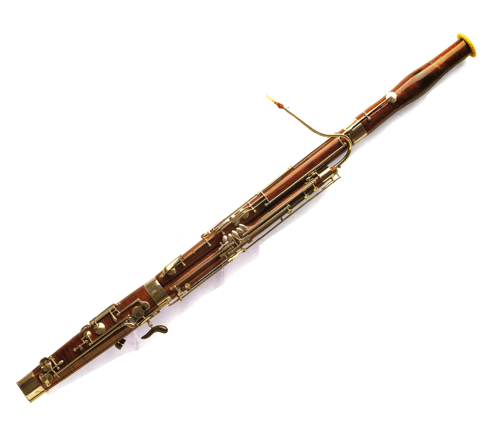
Still, if you take it on it’s own grounds; if you play by its own rules, there is a tightness and syllogism to INCEPTION that’s hard not to like. It’s easy to stitch a tightly-knit fabric when you control the loom: so can you get yourself out of any (narrative) trouble if you’re the one who writes the laws. We can appreciate the final product, but it can never be “great.” Or maybe just this one isn’t. In the end INCEPTION is something of a bassoon: an overwrought, ponderous, behemoth of an instrument, playing an elegant and elegiac song; probably not for everyone.